.gif)
When you spend enough time around athletes, you start hearing the same phrase again and again. "I just couldn't get enough air in."
It happens in the first or the final kilometres of a marathon. It happens during the wall balls at the end of a HYROX race. It happens when a cyclist goes over the red line on a climb or when someone pushes through a brutal interval session and the body's natural reaction is always the same. Breathe faster!
It feels logical. If the body needs more oxygen, then surely the solution is simply to increase breathing rate.
Yet when you look more closely at breathing mechanics during intense exercise, something interesting appears. At a certain point, breathing faster actually makes breathing less efficient.
Understanding why this happens opens the door to better endurance performance, improved breathing control, and a more stable nervous system under pressure.
In exercise physiology, there is a simple relationship that describes breathing during movement.
Minute ventilation equals breathing rate multiplied by tidal volume.
Breathing rate (RR) is how many breaths you take per minute. Tidal volume is how much air moves with each breath.
At low to moderate intensities, some athletes breathe relatively slowly and deeply. The diaphragm is activated, the rib cage expands naturally, and the lungs fill with air. The breathing pattern feels smooth and rhythmic. Easy right?
This is where functional and efficient breathing lives. However, this is for another blog but I have to add that 90% of athletes, maybe more, don't get this part right.
Ventilation can be increased simply by taking slightly deeper, functional breaths while maintaining control of the breathing rhythm.
The trouble begins when breathing frequency starts rising too quickly and we loose control and don't have awareness of it.
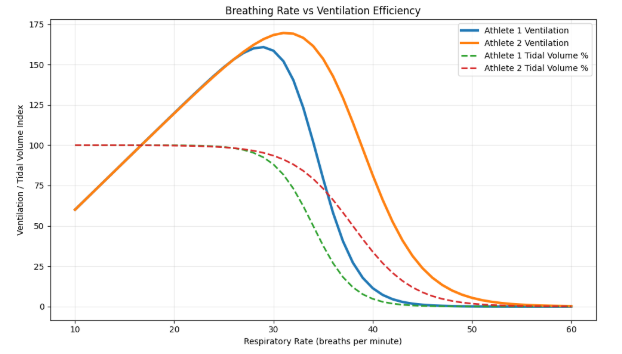
As intensity rises, the body increases breathing rate to deal with rising carbon dioxide and metabolic demand. The problem is that faster breathing reduces the time available for each breath.
Because the inhalation and exhalation becoming shorter the diaphragm has less time to descend and the lungs do not fill as efficiently as required for high performance. This is the moment where breathing shifts from deep and controlled to rapid and shallow.
Many athletes recognise the feeling instantly with symptoms including chest tightening and breathing rising up into the chest and shoulders, tension through the neck, breathing becoming noisy, and the rhythm of movement begins to fall apart.
At this stage the respiratory muscles are working extremely hard just to keep up and blood stealing begins to occur. The breathing breakpoint most athletes hit.
During high-intensity exercise, there is often a point where breathing patterns change dramatically. I like to refer to this as respiratory breakpoint.
For many athletes, this occurs somewhere around thirty to forty breaths per minute. Up to this point, tidal volume can remain relatively high. The lungs are still filling well and ventilation continues to increase efficiently.
Once breathing rate climbs beyond this range, tidal volume begins to collapse. The breaths become shorter and shallower, meaning that even though breathing frequency increases, the amount of useful air moving in and out of the lungs begins to fall and this is why athletes suddenly feel like they cannot catch their breath even though they are breathing rapidly.
It's obviously not a lack of effort as all athletes want to compete at their best. It is a physiological mechanical limitation within the breathing system.
Watch experienced endurance athletes closely during demanding efforts and something becomes clear. Their breathing often looks quieter and more controlled, even when the intensity is high. They are almost always aware of and train their breathing. This is something I see regularly when working with endurance athletes on breathing mechanics and performance.
They maintain larger tidal volumes and resist the shift into rapid shallow breathing for longer and this allows them to sustain higher ventilation with less respiratory strain. They are more efficient.
The ability to maintain efficient breathing mechanics during stressful situations is a major advantage in endurance sport, but the same principle also applies outside of sport.
Executives presenting in high-stakes meetings, leaders making decisions under pressure, and teams operating in fast moving environments all experience the same physiological stress response. This is something we work on regularly through breathing and performance training for high-performance teams.
Breathing is one of the fastest ways to influence that system and this is where breathwork training becomes valuable.
Breathing training is not about relaxation alone. When applied correctly, it can improve respiratory mechanics, strengthen the diaphragm, and help athletes maintain better breathing patterns during demanding efforts.
Methods such as nasal breathing for running performance, diaphragmatic breathing drills, and carbon dioxide tolerance training for athletes can gradually improve breathing efficiency.
These practices help athletes remain composed when intensity rises.
For endurance athletes, this may translate into smoother pacing and reduced respiratory fatigue.
For high-performing teams and leaders, it can support clearer thinking, calmer decision making, and better control of the nervous system during stressful moments.
In both cases the objective is similar. Maintain control of breathing when pressure rises.
Like strength or endurance, breathing mechanics can be trained.
Athletes who develop better breathing awareness during lower intensity training often find that their breathing remains more controlled during competition.
Simple changes such as nasal breathing during easy sessions, breathing drills to strengthen the diaphragm, and improving posture and rib cage mobility can gradually shift breathing patterns.
Over time these improvements support oxygen efficiency in endurance sports and reduce the tendency toward panic breathing when intensity climbs.
The athletes who perform well under pressure are rarely the ones breathing the fastest, but the ones whose breathing is 'odd' as it seems like they aren't under pressure but instead in complete control.
Once an athlete begins breathing rapidly and shallowly during intense exercise the solution is not simply to tell them to breathe slower. By that point the breathing system is already under strain.
What we are dealing with is a respiratory system that has not been trained. If the respiratory muscles are weak, if breathing mechanics are inefficient, or if the athlete has never developed awareness of how they breathe under pressure, the body naturally defaults to over-breathing. The diaphragm begins to fatigue, accessory breathing muscles take over, and breathing becomes chaotic.
This is where we start to see the respiratory metaboreflex at play. When the diaphragm becomes fatigued and secondary breathing muscles demand more oxygen, the begin to pull blood away from the working muscles in the legs to support the breathing muscles. As mentioned previously, this process is described as blood stealing. As blood flow shifts away from the legs fatigue increases and performance drops.
At the same time, another important mechanism begins to break down. The Bohr effect, which allows oxygen to be released efficiently from the blood into working tissues, becomes disrupted when breathing patterns are unstable and carbon dioxide levels fall too low. The body may be flooded with oxygen, but if the chemistry is not right that oxygen cannot be delivered effectively to the cells where it is needed to produce energy and ATP.
So the issue is not oxygen availability. The issue is breathing control and physiological response.
Just like strength, endurance, and mobility, breathing needs to be trained in a systematic way.
The foundation begins with the most basic skill of all. Taking a functional and efficient breath.
Humans take around twenty-four thousand breaths each day. If those breaths are inefficient, the cumulative effect is significant. The goal is to develop the ability to take an optimised breath every time, whether at rest, during training, or under pressure.
Once that foundation is established, the next step is learning to control breathing during lower-intensity movement. This is where nasal breathing and heart rate zone one and two training become extremely useful. Nasal breathing naturally slows the breathing rate, improves carbon dioxide tolerance, and helps develop better breathing mechanics. This is where adaptations take place but the athlete has to be willing to drop their ego for a short time anyway. For some, this can be troubling at first, but the payback are tenfold.
From there, we begin organising breathing with movement through respiratory locomotor coupling. For runners, this often means coordinating breathing with foot strike patterns so the breath and the body move in rhythm together and as intensity increases the training progresses:
Breath-holding on both inhale and exhale begins to challenge carbon dioxide tolerance and strengthen the respiratory muscles. Breathing mobility drills improve rib cage movement and diaphragm function. Higher intensity training begins to incorporate both nasal and mouth breathing as athletes learn to maintain control even when effort levels rise.
At this stage, athletes often begin to notice improvements in their lactate threshold, their recovery between efforts, and their ability to stay calm when the pressure increases.
A key component of this work is respiratory muscle training.
One of the tools I often use with athletes is the Isocapnic breathing device developed in Canada. This device allows athletes to train the breathing muscles while maintaining stable carbon dioxide levels in the blood.
Most breathing trainers simply restrict airflow, which often leads to excessive carbon dioxide loss as breathing rate increases and dizziness. An isocapnic system works differently. It allows athletes to strengthen the respiratory muscles while maintaining healthy carbon dioxide balance, which supports the oxygen delivery process that the body depends on during endurance work.
When breathing training is applied consistently, the results can be significant.
Athletes often report improvements in endurance performance, better control of breathing during high-intensity efforts, improved recovery, deeper sleep, and a greater sense of calm under pressure.
Over time, breathing becomes something that supports performance rather than limiting it.
This is the work we do through my breathing programs. Some athletes begin with a six-week program to establish the fundamentals. Others progress through the ten-week program, where breathing is integrated into endurance training and higher intensity work. For athletes and high-performing individuals and teams who want deeper integration, the six-month program tends to deliver the most meaningful results. This is where breathing becomes fully embedded into training, recovery, and performance environments.
The outcome is simple. Improved breathing leads to better control of the nervous system, better energy management, better performance under pressure and improved recovery.
If this is something you would like to explore, you can book a consultation through the blue button and we can discuss how breathing training may fit into your training or performance environment.
Because when breathing is trained properly, performance under pressure becomes far more sustainable.
Across endurance sport there is growing interest in breathing training as a way to improve performance under pressure. Runners, HYROX athletes, cyclists, and strength endurance competitors are beginning to recognise that breathing mechanics influence everything from pacing and fatigue to recovery and focus.
In the United States in particular, breathwork training for athletes has become a growing area of interest within performance coaching, sport science, and high performance leadership. Teams and individuals are starting to understand that the respiratory system is trainable in the same way as strength, speed, and endurance.
When breathing mechanics are efficient, oxygen delivery improves, carbon dioxide tolerance increases, and athletes are able to sustain higher workloads without losing control of their breathing pattern. The same principles are now being explored outside sport by executives, military teams, and leaders who operate in environments where clear thinking and calm decision making are required under pressure.
Working with a performance breathing coach allows athletes and high performers to build better breathing habits, improve breathing efficiency, and develop control of the nervous system during demanding situations.
Because in both sport and leadership environments, the ability to manage breathing under pressure often determines how well someone performs when it matters most.
When breathing frequency increases too quickly there is less time for each breath. The lungs cannot fill completely and tidal volume drops. This leads to rapid shallow breathing and reduced breathing efficiency.
Yes. Breathwork training for athletes can improve diaphragm function, breathing coordination, and carbon dioxide tolerance. These changes can support better breathing mechanics for athletic performance.
Many athletes reach thirty to forty breaths per minute during demanding exercise. Beyond this range tidal volume often begins to decline rapidly.
Practices such as nasal breathing for running performance, diaphragmatic breathing for runners, and breathing drills to strengthen the diaphragm can improve breathing efficiency over time.
Yes. Many athletes, executives, and high performing teams use breathing techniques to regulate their nervous system and maintain focus during demanding situations.
If you are an athlete or part of a high-performance team and would like to understand how breathing affects performance under pressure, you can book a consultation here.


