.gif)
England survived a scare against DR Congo, and sometimes that is what tournament football becomes. Not always fluent, not always pretty, but enough to stay alive. Harry Kane's late double turned what could have become a deeply uncomfortable evening into another knockout win, with Jude Bellingham and England's attacking players spending long periods trying to force a way through before the captain eventually did what he has done so often: arrive when the pressure is highest.
Their reward is Mexico at the Azteca Stadium and that is where the story changes.
England now move from Atlanta to Mexico City, more than 2,200 metres above sea level, where the physical demands are very different. Looking ahead to the match, Thomas Tuchel admitted: "The altitude will be a big disadvantage because we cannot physically adapt to it. It just takes too much time."
Tuchel is right. The human body does not adapt to altitude in four days. The bigger changes that improve oxygen transport, red blood cell production and tolerance to reduced oxygen availability take longer. England will have to cope with the conditions as they are, while Mexico walk into the game with a clear environmental advantage.
Interestingly, sports scientists often recommend one of two approaches when competing at altitude: arrive well in advance, typically around 10 days or more, allowing the body time to begin acclimatising, or arrive as close to competition as possible to avoid spending several days in the early stages of altitude exposure, when breathing is harder, sleep can be disrupted and performance often feels at its worst. England's schedule leaves them somewhere in between, with too little time to fully adapt but long enough to experience some of the immediate physiological challenges.
What interests me is not whether England can suddenly become acclimatised before kick-off. They can't. The more interesting question is whether breathing and respiratory training should already have been part of the long-term preparation.
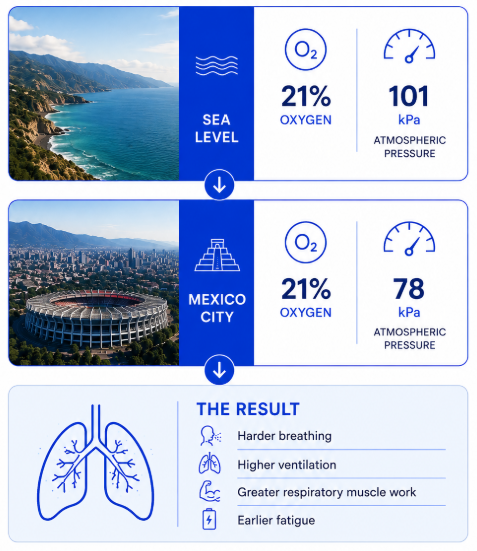
Altitude is often described as "less oxygen", but that phrase can be misleading. The air in Mexico City still contains roughly 21% oxygen, just as it does at sea level. What changes is barometric pressure. As pressure falls, there are fewer oxygen molecules available in each breath, which reduces the pressure gradient that helps oxygen move from the lungs into the blood. The body responds by increasing ventilation. Breathing rate rises, breathing depth often changes and minute ventilation increases as the body tries to defend oxygen delivery. That response is essential, but it has a cost.
While breathing training cannot replace altitude acclimatisation, it can become part of the preparation long before a tournament begins. Techniques such as respiratory muscle training and intermittent hypoxic-hypercapnic training, which combines brief periods of reduced oxygen and elevated carbon dioxide through carefully prescribed breath-hold exercises, are being investigated as ways to improve breathing efficiency and resilience under physiological stress. They're not a substitute for spending time at altitude, but they may help athletes arrive better prepared when the work of breathing suddenly increases. If you'd like to explore the science in more detail, I've covered it in my Insights What Happens When You Sprint with Less Oxygen? Find Out. and Hypercapnic & Hypoxic Breathwork for VO₂ Max.
As breathing becomes harder, the respiratory muscles have to work harder too. The diaphragm, intercostals and accessory breathing muscles all require oxygen and energy, just like the muscles in the legs. If those breathing muscles begin to fatigue, the body can trigger what's known as the respiratory muscle metaboreflex. Put simply, it prioritises blood flow to the muscles responsible for breathing, even if that means reducing blood flow to the working muscles in the arms and legs. At altitude, where the respiratory system is already under greater strain, that becomes an important consideration. The more efficiently an athlete can breathe, the less likely they are to waste valuable energy simply trying to move air.
This is where football needs to look beyond altitude camps and oxygen masks and start asking better questions about respiratory performance. Breathing training will not replace acclimatisation. It will not magically remove the demands of Mexico City. But breathing mechanics, respiratory muscle strength, carbon dioxide tolerance and recovery breathing are all trainable qualities, and they should be treated as part of performance preparation rather than something left to chance.
At altitude, players will naturally breathe more. The challenge is whether they can breathe efficiently. An athlete with poor breathing mechanics, limited rib movement or an over-reliance on upper-chest breathing is likely to spend more energy moving air than they need to. Over a full match, especially at altitude, those small inefficiencies can accumulate. Football is often decided late, when fatigue, pressure and decision-making collide. England saw that against DR Congo. Panic was beginning to creep in before Kane changed the game. Against Mexico, in thinner air, those final twenty minutes could become even more important.
I've seen this repeatedly in my own coaching. Athletes rarely come to me because they want to "breathe better" in isolation. Footballers want to last longer and stay sharper. Cyclists want to hold position and recover faster. Runners want to stop blowing up. Executives want to speak clearly under pressure. The goals differ, but the underlying physiology is often connected. When breathing becomes more efficient, recovery improves, tension reduces and athletes often become better able to access the performance they already have.
Strength is trained. Speed is trained. Endurance is trained. Tactical understanding is trained. Yet the system responsible for bringing air into the body, managing carbon dioxide, supporting recovery and influencing the nervous system is still too often treated as if it will simply organise itself.
Whether Mexico vs England is decided by altitude, tactics or one moment of individual brilliance, Kane, Bellingham and the rest of the team will still need to perform technically, tactically and emotionally in one of world football's most demanding environments. But Tuchel's comments should start a bigger conversation.
If elite football knows altitude can shape World Cup matches, why is respiratory training not already embedded into the way teams prepare?
That conversation should not begin four days before playing at the Azteca. It should have started years ago.
I'm Thomas Hague, founder of The Breath Coach.
I help athletes, sports teams, businesses and leaders improve performance through breathing assessment, respiratory training and nervous system regulation.
This is one of my Breath Coach Insights, a collection of evidence-based articles exploring the hidden physiology behind health, performance and recovery. If you'd like to explore more, browse the rest of the Insights section or learn more about coaching and workshops throughout the website.
If you found this Insight useful, you might also enjoy some of the articles below. Together, they explore the science of breathing, respiratory physiology and how breathing influences health, performance, recovery and resilience under pressure.
Can England acclimatise to Mexico City's altitude in four days?
No. Full altitude acclimatisation takes considerably longer than four days. While players can make small adjustments before the match, the physiological adaptations that improve oxygen transport and performance at altitude develop over weeks, not days.
Why is football more difficult at altitude?
At altitude, atmospheric pressure is lower, reducing the partial pressure of oxygen. This means less oxygen is available with each breath, causing players to breathe harder, fatigue sooner and recover more slowly during repeated high-intensity efforts.
Can breathing training help footballers perform at altitude?
Breathing training cannot replace altitude acclimatisation. However, improving breathing mechanics, respiratory muscle strength and breathing efficiency may help athletes reduce the work of breathing and cope more effectively when oxygen availability is reduced.
What is the respiratory muscle metaboreflex?
The respiratory muscle metaboreflex is a protective physiological response. When the breathing muscles become fatigued, the body prioritises blood flow to those muscles, which can reduce blood flow to the working muscles in the arms and legs. This may contribute to fatigue during intense exercise.
Is breathing a trainable part of performance?
Yes. Like strength, endurance and speed, breathing can be assessed and trained. Improving breathing mechanics, respiratory muscle function and breathing efficiency may enhance performance, recovery and resilience under pressure.


