.gif)
Novak Djokovic returns to Wimbledon looking to add another Grand Slam title to one of the greatest careers tennis has ever seen. At 39 years of age he's still competing with players more than a decade younger than him, and every tournament seems to raise the same question. How has Novak Djokovic managed to stay at the very top of professional tennis for more than twenty years, and what role has breathing played in helping him perform under pressure?
There isn't a single answer. Throughout his career Djokovic has spoken openly about nutrition, recovery, sleep, flexibility and mindset. Breathing has appeared in that conversation more than once, including after winning Olympic gold in Paris in 2024 when he described conscious breathing as one of the most important things an athlete can learn.
"The number one thing is to learn how to consciously breathe."
I found that interesting because breathing rarely gets discussed alongside the things we normally associate with elite performance. Strength does. Speed does. Recovery certainly does. Breathing usually sits quietly in the background, doing its job without demanding much attention. Djokovic clearly sees it as something worth developing, and I think it's worth exploring why.
As a breathing coach, one phrase I use a lot is that breathing is a training variable. We already accept that strength, speed, mobility and endurance can all be trained and improved. We assess them, measure them and spend hours trying to make small improvements because we know those improvements add up over time. I think breathing deserves exactly the same attention.
Most of us will take somewhere between 20,000 and 24,000 breaths today without thinking about a single one of them. That's how the body is designed to work. Breathing is automatic, but it isn't fixed. Like movement, it can become more efficient, more economical and better suited to the demands we place on it.
Once you begin looking at breathing as part of performance training, different questions start appearing. How efficiently am I breathing? What happens to my breathing when intensity increases? How does my breathing change under pressure? How much energy am I using simply to breathe? Those questions often tell us far more than simply asking whether somebody breathes through their nose or their mouth.
The more I coach, the more I realise breathing sits underneath almost everything an athlete does. It influences sleep, recovery, movement, decision-making, nervous system regulation and the ability to stay composed when the pressure starts building. Those aren't separate systems. They're all connected, and breathing quietly links every one of them together.
Djokovic has spoken about conscious breathing in another interview that I think is just as revealing. During his conversation with 60 Minutes, he was asked about his mental strength and whether it was something he'd always had. His response was that it wasn't a gift, it was something he'd worked on. When he was asked how, conscious breathing formed part of the answer.
"There are different techniques. Conscious breathing is a big part. Especially in the moment where you are under tension."
That makes complete sense because pressure doesn't only affect the mind, it changes the body as well. Breathing becomes quicker, heart rate rises, muscles become more tense and attention naturally starts drifting away from the task in front of us. Every athlete experiences that to some degree, whether it's serving for a Wimbledon title, standing over a penalty or delivering a presentation in front of hundreds of people. The athletes who seem to deal with those moments best aren't immune to pressure; they've simply developed ways of recognising what's happening and bringing themselves back under control. That's where breathing becomes so valuable. If you've trained it consistently enough away from competition, it gives you something familiar to come back to when everything else around you starts speeding up.
It's easy to watch Djokovic taking a slow breath between points and assume that's where the work happens. I don't think it does. The breathing you see on Centre Court is almost certainly the result of habits built months beforehand. Like every other skill, it needs to be practised often enough that it becomes automatic. By the time the pressure arrives, breathing shouldn't feel like another technique to remember. It should simply be part of the way the athlete performs.
Obviously, none of us know exactly what Novak Djokovic and his team do behind closed doors, and I wouldn't pretend otherwise. Elite athletes rarely share every detail of how they prepare because those details often become part of the competitive advantage they've spent years building.
If Novak Djokovic walked through the door at The Breath Coach tomorrow, I wouldn't be looking for one magic exercise or one breathing technique. I'd want to understand how he breathes during the other twenty-three hours of the day because that's where habits are built. The breathing you see on Centre Court is only a small part of the picture.
One of the first things I'd look at is an athlete's respiratory rate, but I wouldn't stop there. Respiratory rate multiplied by tidal volume gives us minute ventilation, the total volume of air moving in and out of the lungs every minute. That's where things become interesting because two athletes can have exactly the same respiratory rate but very different minute ventilations. One might be breathing quietly and efficiently, while the other is moving far more air than they need to. That unnecessary ventilation increases the work of the respiratory muscles, lowers carbon dioxide levels and shifts blood pH towards a more alkaline state. As that happens, haemoglobin becomes less willing to release oxygen into the working muscles, brain and other tissues where it's needed most. Measuring minute ventilation gives me a much clearer picture of how efficiently an athlete is breathing and where the biggest opportunities for improvement are, long before we start talking about performance under pressure.
I'd also be looking at breathing mechanics, diaphragm function, rib cage mobility, respiratory muscle strength, carbon dioxide tolerance and the way breathing changes as exercise intensity increases. From there, breathing becomes part of the programme rather than another session squeezed into an already busy week. Zone 2 work becomes an opportunity to improve breathing efficiency through comfortable nasal breathing. Warm-ups become an opportunity to prepare the respiratory muscles before stepping onto the court. Recovery begins with the first breath after the final point rather than waiting until the athlete gets back to the changing room. Over time those habits stop feeling like breathing exercises because they become part of the way the athlete prepares, competes and recovers every single day.
During his interview with 60 Minutes, Novak Djokovic was asked about the mental strength that has become one of the defining parts of his career.
His answer probably wasn't what most people expected.
"I might appear maybe locked in. But trust me, there is a storm inside. The biggest battle is within."
From the outside, Djokovic often looks completely composed. He rarely shows frustration for long, recovers quickly after losing points and seems able to settle himself before the next rally begins. Listening to that interview, it's clear the experience is very different from the one people watching from the stands or at home imagine. The pressure is still there. The emotion is still there. The internal battle doesn't disappear simply because you've won Grand Slam titles.
A few moments later he explained that conscious breathing is one of the techniques he comes back to when the pressure starts building.
"There are different techniques. Conscious breathing is a big part. Especially in the moment where you are under tension."
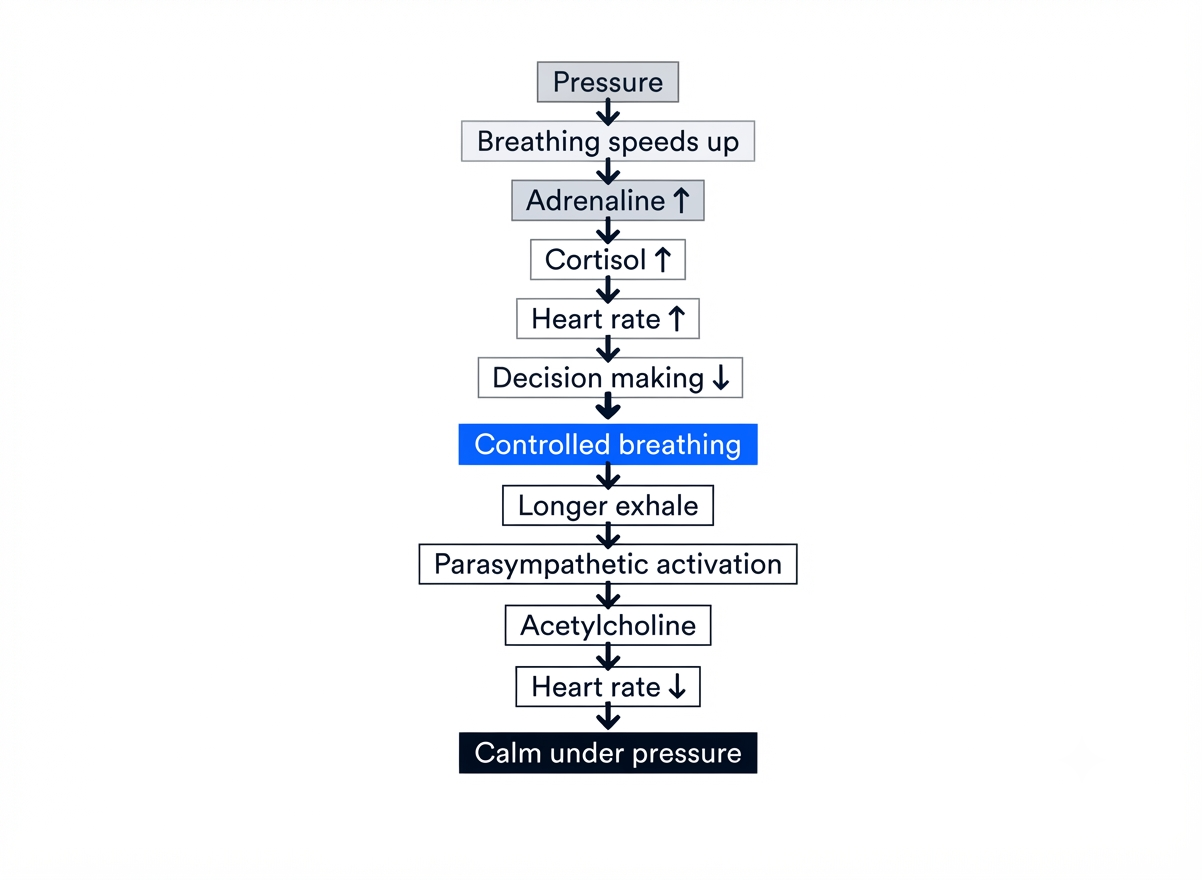
Those two quotes tell us a lot. Pressure changes breathing almost immediately. Heart rate rises, muscles become more tense and breathing usually becomes quicker and less efficient. Those changes are part of the body's normal stress response, but they also make it harder to think clearly, make good decisions and execute skills consistently. If breathing has become part of your training long before competition, it gives you something familiar to return to when those moments arrive.
That's one of the reasons I see breathing as a training variable. It doesn't remove pressure, and it certainly doesn't guarantee performance. What it can do is help an athlete regain control more quickly when everything around them starts speeding up.
If I was coaching an athlete competing at Novak Djokovic's level, I wouldn't start by looking at what happens between points. I'd start by looking at the other twenty-three hours of the day because that's where breathing habits are built.
I'd want to understand how efficiently they're breathing at rest, how well they're sleep and recover, how their breathing changes as exercise intensity increases and how much work the respiratory system is actually doing before training has even started.
One of the first things I'd assess is respiratory rate, but I wouldn't stop there. Respiratory rate multiplied by tidal volume gives us minute ventilation, the total volume of air moving in and out of the lungs every minute. That's where things become interesting because two athletes can have exactly the same respiratory rate but very different minute ventilations. One might be breathing quietly and efficiently, while the other is moving far more air than they need to. That unnecessary ventilation increases the work of the respiratory muscles, lowers carbon dioxide levels and shifts blood pH towards a more alkaline state. As that happens, haemoglobin becomes less willing to release oxygen into the working muscles, brain and other tissues where it's needed most. Measuring minute ventilation gives me a much clearer picture of how efficiently an athlete is breathing and where the biggest opportunities for improvement are.
I'd also spend time assessing the diaphragm itself. How strong is it? Is it working efficiently? Is it relaxed enough to move through its full range, or is it carrying unnecessary tension? Djokovic has occasionally been seen working around the area of his diaphragm and lower rib cage during matches. While we can't know exactly why, it highlights something many athletes overlook. The diaphragm is far more than a breathing muscle. It influences breathing rate, tidal volume and minute ventilation, but it also contributes to spinal stability, thoracic mobility and the transfer of force throughout the body. Developing an awareness of how the diaphragm feels and functions is an important part of improving performance. If an athlete can recognise when it's restricted, fatigued or under unnecessary tension, they have another tool to help regulate breathing and stay composed under pressure.
The diaphragm sits at the centre of an integrated movement system. It works alongside the abdominal wall, pelvic floor and the deep muscles of the spine to create stability before movement even begins. Every serve, every change of direction and every rotation through the trunk rely on that system working efficiently. Restrictions around the diaphragm, rib cage and thoracic spine don't just influence breathing. They can influence shoulder rotation, spinal flexion and extension, pelvic control and the way force is transferred through the hips, knees, ankles and feet. That's one of the reasons I spend so much time assessing breathing mechanics before introducing breathing drills. Improve the way the diaphragm moves and it's remarkable how often the rest of the body starts moving differently as well.
From there I'd assess respiratory muscle strength, breathing mechanics, carbon dioxide tolerance and the way breathing changes as exercise intensity increases. I'd assess how breathing behaves around lactate threshold, how efficiently the athlete buffers rising acidity and whether breathing is supporting or limiting performance as fatigue begins to build. During running, I'd also assess respiratory locomotor coupling, looking at how breathing synchronises with movement and whether small adjustments in breathing rhythm could improve efficiency and reduce the overall cost of exercise.
Breath holds would also form part of the programme, but not simply to see how long an athlete could hold their breath. They're one of the ways I help athletes prepare for pressure before competition ever begins. As carbon dioxide rises and the urge to breathe becomes stronger, the nervous system naturally becomes more alert because the brain interprets those signals as a potential threat. Learning to stay relaxed, think clearly and remain in control during that discomfort is directly transferable to competition. Physiologically, repeated breath-hold training also exposes the body to controlled periods of lower oxygen and higher carbon dioxide, creating a training stimulus that can improve carbon dioxide tolerance, influence lactate buffering and strengthen the respiratory system. If an athlete can stay calm during a well-structured breath hold, they're much more likely to stay calm when the pressure starts building on court.
I'd also incorporate isocapnic respiratory muscle training where appropriate. Unlike traditional respiratory muscle trainers, an isocapnic device allows athletes to strengthen the breathing muscles while maintaining carbon dioxide levels throughout the session. That means the training remains specific, measurable and repeatable without the dizziness many athletes experience when using conventional respiratory muscle training devices. I've written more about that approach in my Insight on isocapnic respiratory muscle training, where I explain why it's become part of the way I work with athletes.
By that stage, breathing has stopped being another session squeezed into an already busy training week. It becomes part of everything the athlete already does. Zone 2 work becomes an opportunity to improve breathing efficiency through comfortable nasal breathing. Warm-ups prepare the respiratory muscles alongside the rest of the body. Recovery begins with the first breath after the final point rather than waiting until the athlete walks off court. Over time those habits become automatic, which is exactly what you're looking for when the biggest moments arrive.
Whether Novak Djokovic wins another Wimbledon title this year doesn't really change the conversation.
After more than twenty years at the top of professional tennis, breathing is still something he chooses to talk about. We don't know exactly how he trains it, and we don't need to. The interviews tell us enough. He sees conscious breathing as part of his preparation and part of the way he responds when the pressure is at its highest.
The more I coach athletes, the more I see breathing influencing movement, recovery, sleep, respiratory muscle function and the ability to stay composed under pressure. Those aren't separate systems. They're connected, and breathing sits underneath every one of them.
That's why I describe breathing as a training variable. Like strength, speed, mobility and endurance, it can be assessed, measured and improved. Ignore it and the body will continue breathing automatically. Train it with purpose and it becomes another part of performance that continues developing throughout an athlete's career.
After more than twenty years at the top of world tennis, Novak Djokovic still believes breathing is worth practising.
Novak Djokovic has spoken publicly about conscious breathing for several years. In interviews, including after winning Olympic gold in Paris and during his conversation with 60 Minutes, he describes breathing as one of the techniques he uses to help regulate himself when the pressure starts building. Rather than trying to eliminate stress, breathing appears to help him reset between points, regain control of his physiology and refocus on the next rally.
Djokovic hasn't revealed his complete breathing programme, and it's unlikely he ever will. Elite athletes rarely share every detail of their preparation. What he has said is that conscious breathing forms part of his approach to performing under pressure. Looking at his matches, it's common to see him slow his breathing between points, using the time available to recover physically and mentally before the next rally begins.
Pressure activates the body's natural stress response. Adrenaline and cortisol are released, heart rate rises, muscles become more tense and breathing naturally becomes quicker and shallower as the body prepares for action. That's a normal physiological response, but if it continues for too long it can make clear thinking, decision-making and skilled movement more difficult.
Learning to recognise those changes and respond with controlled breathing helps bring the nervous system back towards balance. Slowing the breathing and allowing the exhale to become slightly longer than the inhale increases parasympathetic activity through the vagus nerve. One of the main neurotransmitters involved in that response is acetylcholine, which helps slow the heart, reduce physiological arousal and create the conditions for clearer thinking under pressure.
It doesn't make the pressure disappear. It helps you regain control of your response to it.
Breathing won't remove pressure, and it won't guarantee performance. What it can do is influence how you respond when pressure arrives. Consistent breathing training can improve breathing efficiency, help regulate the nervous system and provide athletes with a practical tool to return to when emotions and physiological arousal begin increasing. That's one of the reasons breathing has become part of the preparation of many elite performers across sport.
Breathing won't replace technical ability, fitness or good coaching, but it can support all of them. Efficient breathing may improve recovery between points, reduce the work of the respiratory muscles, improve movement quality and help athletes stay calmer when matches become physically and mentally demanding. Over the course of a long tennis match, those small advantages can become increasingly valuable.
Most people think oxygen is the only gas that matters during exercise, but carbon dioxide plays an equally important role. Carbon dioxide helps regulate blood pH and encourages haemoglobin to release oxygen into the working muscles, brain and other tissues where it's needed. Athletes who habitually over-breathe can lower carbon dioxide excessively, making oxygen delivery less efficient even though they're breathing more. That's one of the reasons improving breathing efficiency and carbon dioxide tolerance has become such an important area of performance coaching.
Minute ventilation is the total volume of air moving in and out of the lungs every minute. It's calculated by multiplying respiratory rate by tidal volume.
Two athletes can have exactly the same breathing rate but very different minute ventilations. One may be breathing quietly and efficiently, while the other is moving far more air than necessary. Assessing minute ventilation provides valuable insight into breathing efficiency and is one of the first measurements I'd look at when working with an athlete.
Absolutely. The same physiology applies whether you're competing in a Wimbledon final, running your first 10K or playing Sunday league football. Breathing influences movement, recovery, sleep, nervous system regulation and the ability to perform under pressure. Those are qualities that matter at every level of sport, not just at the top.
When I work with an athlete, I'm not simply teaching breathing exercises. I'll assess breathing mechanics, respiratory rate, minute ventilation, diaphragm function, thoracic mobility, respiratory muscle strength, carbon dioxide tolerance and how breathing changes as exercise intensity increases. I'll also look at how breathing influences movement, recovery and the ability to stay calm under pressure. That assessment helps identify where breathing may be limiting performance and where the greatest opportunities for improvement lie.
Keep learning with these related Insights:
I'm Thomas Hague, founder of The Breath Coach.
I work with athletes, coaches and organisations across the UK, helping them improve health, performance and recovery through evidence-based breathing training.
My coaching combines breathing mechanics, respiratory physiology and nervous system regulation to help people perform more efficiently, recover more effectively and stay calm under pressure.
Whether you're preparing for a major competition, returning from injury or simply looking to understand how your breathing influences performance, the principles remain the same. Breathing is a training variable, and like strength, mobility and endurance, it can be assessed, measured and improved.
If you'd like to understand how your breathing is influencing your health, performance or ability to stay calm under pressure, I'd be happy to help.
I work with:
You can find out more about one-to-one coaching, workshops and performance programmes by getting in touch below.
Reading about breathing is one thing. Putting it into practice is where the real improvements begin.
I've created a free guide, Performance Under Pressure, to help you understand the fundamentals of breathing training and show you where to start.
Inside you'll discover:
Whether you're an athlete, coach or simply interested in improving your health and performance, it's a practical introduction to the methods I use every day with clients.
Download your free copy of Performance Under Pressure and take the first step towards training your breathing with purpose.
Download the Free Performance Under Pressure Guide


